
Huge
Studio XL
Studio XL is Huge's dedicated in-house agency for Google. I was brought in to lead the G Suite account from Huge's Oakland office, with a team based in Bogotá, when the account was still small. Over two years I grew it into design leadership across Google Cloud and Chrome Enterprise, plus a range of smaller product and cultural moments for Google.
Role
Principal Product Designer
2025
Responsibilities
Design
UX Research
Principal Product Designer
2025
Responsibilities
Design
UX Research
Studio XL
Studio XL is Huge's dedicated in-house agency for Google, built because Google's design needs outgrew what any single account could cover. Some teams had embedded design, most didn't, and the studio existed to serve the ones that didn't.
Starting small
I was brought in to lead G Suite from Huge's Oakland office, with my team based in Bogotá. The account was small when I inherited it. Two years later I was leading design across three major accounts and contributing to half a dozen more.
Building the connective tissue
As the account list grew, I made sure it didn't grow into silos. I ran knowledge-sharing across teams, supported new hires as they ramped, and took on resourcing, planning, and strategy for accounts beyond my own whenever a gap opened up.
G Suite
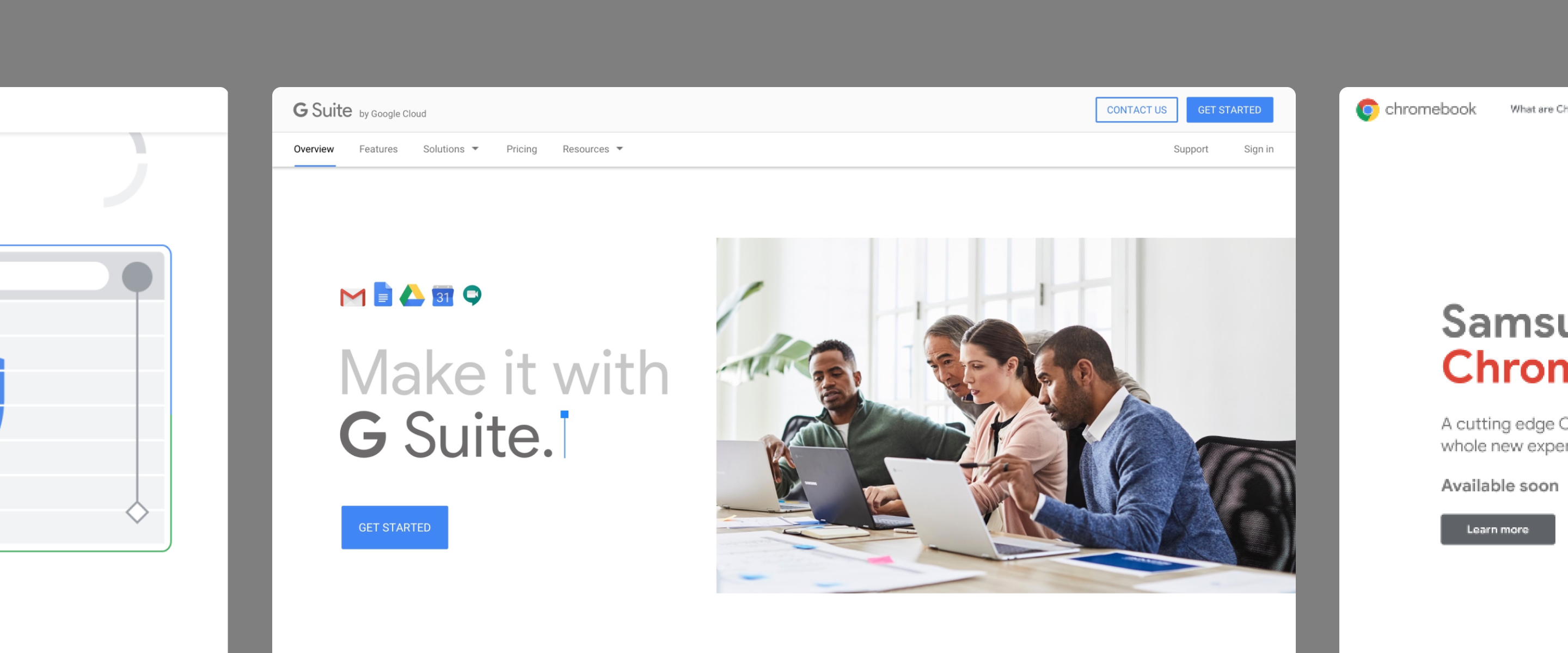
G Suite reached over two billion monthly active users during my time on the account, one of the most widely used products Google has ever shipped. I inherited a design system that hadn't kept pace with it, leading a team based in Bogotá while I worked the relationship from Oakland. The client's instinct was caution. Do no harm to something that big.
We worked together to earn room to experiment, a navigation test here, a new page there, until change stopped feeling risky and started feeling normal. The design system was the biggest win: once it was in place, my team and our embedded engineers could publish new page designs fast, homepage, pricing, and beyond, without every launch being its own negotiation. The relationships we built doing it became part of how Huge grew inside Google.
We worked together to earn room to experiment, a navigation test here, a new page there, until change stopped feeling risky and started feeling normal. The design system was the biggest win: once it was in place, my team and our embedded engineers could publish new page designs fast, homepage, pricing, and beyond, without every launch being its own negotiation. The relationships we built doing it became part of how Huge grew inside Google.
What brands needed
Google Cloud
Google Cloud is one of the three major cloud platforms in the world, and the site had grown without ever catching up to that scale. I led the redesign that brought it in line: a new componentized design system the whole site could run on, redesigned article pages, and a run of special projects that needed a different treatment than the core pages.
None of it happened in isolation. I worked alongside Google's own designers, outside consultants, Google's Design governance team, and stakeholders across the org, on a property serving enterprise customers at a scale few products ever reach. Getting a site that size to launch as one coherent thing, on schedule, was the win.
None of it happened in isolation. I worked alongside Google's own designers, outside consultants, Google's Design governance team, and stakeholders across the org, on a property serving enterprise customers at a scale few products ever reach. Getting a site that size to launch as one coherent thing, on schedule, was the win.
What brands needed
Chrome Enterprise
Chrome Enterprise started as a tech-stack migration, the kind of project that isn't supposed to touch design. It became a full redesign. I pitched the visual direction, the layouts, and a new content strategy, working with a content strategist to make sure the site said the right thing and not just looked right.
We built the components and launched in a few months, fast for a full redesign, because the system underneath it was built to move quickly from day one.
We built the components and launched in a few months, fast for a full redesign, because the system underneath it was built to move quickly from day one.
What brands needed
And more
Not every project was a redesign. Chrome.com and Chromebooks needed ongoing design support to keep pace with product changes. Flutter and Google Play needed work that could hold up next to Google's own design language. Change the Game needed something with more cultural weight than a product page usually carries. Android had its own room, its own strong point of view. Across all of it, the job was the same: understand what the moment needed and design for that, not for a template.
What brands needed
What I'd do differently
The trust that made Studio XL work came from always being available and always executing at a high bar, on iterative work that didn't always get recognized the way flashier launches did. I'd do the same thing again. But I'd be more deliberate about documenting that impact as it happened, not just delivering it, so the value of steady, unglamorous work was visible beyond the room it happened in.
Where it went next
Studio XL kept growing past what I built. The foundation held: the design system practices and the cross-office collaboration model outlived my time leading it.